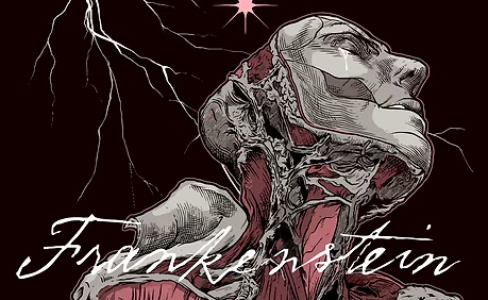
The X-Files: I Want to Believe – Vrach Frankenshteyn Director’s Cut Review (2026)
The Truth Is Out There… Along With a Disturbing Amount of Human Body Parts
Let’s Start by Showing Y’all the Trailers, Shall We?
And if anyone is wondering what Vrach Frankenshteyn translates into, its translates to Dr. Frankenstein, so yes technically we have another Frankenstein review, oh goodie.
I need to get this off the bat, what about this film felt like an R rated film? It really felt like I was watching the same movie from back in 2008.
The X-Files: I Want to Believe has always been the strange child of The X-Files franchise. Released in 2008, a decade after Fight the Future, it brought David Duchovny and Gillian Anderson back as Fox Mulder and Dana Scully for a much smaller, darker standalone mystery. Now Chris Carter has returned to the film with the R-rated director’s cut, subtitled Vrach Frankenshteyn, allowing the movie to lean considerably harder into the gruesome medical horror that was previously restrained.
And after watching this version, I can comfortably say this is a massive improvement over the original cut.
Is it suddenly an amazing X-Files movie? No. In fact, one of my biggest problems remains that this barely feels like an X-Files story at all. But as a bleak, eerie horror thriller, this new version works considerably better.
Non-Spoiler Plot Overview
Years after leaving the FBI behind, Fox Mulder and Dana Scully have gone in very different directions. Mulder has essentially withdrawn from the world while Scully has returned to medicine, working as a doctor at a Catholic hospital.
When an FBI agent disappears under mysterious circumstances, the Bureau approaches Scully hoping that she can convince Mulder to assist with the investigation. Their only lead comes from Father Joseph Crissman, a disgraced Catholic priest who claims to be experiencing psychic visions connected to the missing woman.
Mulder, naturally, is intrigued.
Scully, naturally, is skeptical.
The investigation takes them into a bleak, snow-covered landscape where increasingly disturbing discoveries suggest that the missing woman may be part of something much larger and considerably more gruesome than a straightforward kidnapping.
Meanwhile, Scully becomes personally invested in treating a seriously ill young boy named Christian, putting her at odds with the hospital and eventually the boy’s parents over how far she should go in attempting to save his life.
The director’s cut follows essentially the same central story as the original movie, but its R-rated presentation makes the darker elements considerably more explicit. What was already an unsettling investigation eventually becomes full-blown medical body horror.
Character Rundown
David Duchovny remains excellent as Fox Mulder. My feelings toward Mulder here haven’t really changed from the original cut. He’s still recognizably the same wonderfully strange, obsessive investigator we’ve followed throughout The X-Files. Years away from the FBI haven’t removed his compulsion to investigate something when he believes there is a truth waiting to be uncovered.
And one thing I’ve always appreciated about Mulder is how comfortable he is with being considered weird. People have spent years calling him “Spooky Mulder,” laughing at his theories and treating him like the lunatic working in the basement, and his general attitude is basically, “Yeah, I’m weird. So what?” He doesn’t allow other people’s opinion of him to dictate how he sees himself.
Gillian Anderson is equally strong as Dana Scully. Again, this director’s cut hasn’t fundamentally changed my feelings about her role. Scully is considerably more reluctant than Mulder to become involved with this case, and much of her story instead revolves around Christian and her increasingly desperate attempts to help him.
Unfortunately, that subplot is also one of my biggest problems with the movie.
Father Joe is certainly memorable, but not necessarily for reasons that make me enjoy having him around. The idea of a Catholic priest receiving genuine psychic visions is absolutely something that could work in The X-Files. The problem is that Father Joe is also a convicted child molester.
That makes practically every scene involving him deeply uncomfortable.
I understand what Chris Carter is attempting. Can someone who has committed unforgivable acts nevertheless be used to accomplish something good? Does helping save someone now constitute redemption? Can Scully separate the information Father Joe provides from the horrible things he did?
Those are legitimate questions, but I’m not convinced this movie benefits from making its central psychic character a pedophile. When Scully confronts him, his tendency to frame things through God and divine purpose doesn’t exactly make him more sympathetic either. I spent much more time being uncomfortable around this character than fascinated by his visions.
Then we have Walter Skinner.
I love Skinner. Mitch Pileggi slipping back into the role immediately works, and his relationship with Mulder and Scully still has that wonderful mixture of authority, respect and exhausted affection.
Unfortunately, Skinner feels hilariously out of place in this movie.
He’s absent for almost the entire story before suddenly appearing during the third act when Scully needs somebody willing to actually help her find Mulder. His entrance is satisfying because it’s Skinner, but structurally it feels like somebody suddenly realized they were making an X-Files movie and went:
“WAIT! WE FORGOT SKINNER!”
His little interaction with Scully while they’re searching for Mulder is fantastic. Skinner tries reassuring her that Mulder is smart enough not to do anything stupid, Scully gives him the appropriate “Have you actually met Mulder?” look, and Skinner essentially has to amend that to not doing anything overly stupid.
That’s classic Skinner.
He respects Mulder enormously while simultaneously thinking the man is one of the weirdest people he’s ever met.
I just wish Skinner had been organically involved much earlier rather than feeling like a third-act guest appearance.
The new FBI characters, meanwhile, are considerably less memorable. Agent Mosley Drummy and the other Bureau personnel never come remotely close to leaving the impression that Mulder, Scully and Skinner do.
Pacing / Episode Flow
This remains a deliberately slow movie.
The first two acts are much more interested in atmosphere, investigation and character drama than delivering constant horror. Snow-covered landscapes, isolated roads, gloomy interiors and the generally muted presentation create an effectively oppressive atmosphere.
This movie is bleak.
Really bleak.
And the director’s cut emphasizes that even further.
The problem is that Scully’s hospital storyline often feels like we’re cutting away to an entirely different movie. Mulder is investigating missing women and increasingly horrific discoveries while Scully is involved in a medical drama surrounding Christian’s illness.
Thematically, I understand the connection. Both Mulder and Scully are refusing to give up when other people are telling them that they should. Mulder won’t abandon the investigation, and Scully refuses to simply accept that Christian cannot be helped.
But structurally, these storylines don’t always complement each other.
One moment we’re dealing with dismembered bodies and a horrifying criminal investigation.
Then we’re back at the hospital discussing Christian’s treatment.
It can feel like Mulder and Scully are starring in two separate television episodes that occasionally remember they’re supposed to be part of the same movie.
The third act, however, is where Vrach Frankenshteyn really earns its existence.
This version becomes considerably nastier, more disturbing and more openly horrific than the theatrical cut. The movie finally embraces the grotesque Frankenstein imagery that was always hiding underneath the story, and it’s easily where the director’s cut improves the original most substantially.
Pros
The atmosphere is excellent. The snow, isolation and grim cinematography create an eerie feeling that hangs over practically the entire investigation. There’s something particularly effective about horrible things happening in these quiet, remote locations surrounded by endless white landscapes.
Mulder and Scully remain the movie’s strongest asset. Duchovny and Anderson understand these characters so completely that even when the screenplay around them isn’t firing on all cylinders, their presence carries the movie.
The director’s cut also significantly improves the horror. The R-rated material makes the medical experimentation much more upsetting, and the third act becomes genuinely gross.
And I mean gross.
Once Mulder discovers what’s actually happening, the movie finally reveals the full nightmare behind the disappearances. Organ harvesting, dismemberment, human experimentation and the villains’ ultimate Frankenstein-inspired plan push the movie into much nastier territory than its earlier procedural structure suggests.
The two-headed dog is also one of the genuinely bizarre pieces of evidence demonstrating that these criminals have managed to accomplish something scientifically extraordinary. Why they specifically decided they needed a two-headed guard dog is another question entirely, but it’s certainly one of the most traditionally X-Files-looking things in the movie.
Skinner’s late arrival is also a highlight despite my problems with how he’s incorporated. The second he appears, the movie suddenly gets a little burst of the chemistry and personality I’ve always loved about the series.
Cons
Firstly nothing about this film feels like its an R rated film, felt exactly the same as the 2008 film.
My biggest problem is surprisingly simple:
This doesn’t really feel like an X-Files movie.
Yes, Father Joe experiences psychic visions.
Yes, there’s a surgically created two-headed dog.
Yes, the villains are attempting something straight out of Frankenstein.
But most of the central story is ultimately about human criminals kidnapping women, dismembering them, harvesting organs and conducting illegal medical experiments.
That’s horrifying.
But what about that inherently screams The X-Files?
For large portions of the movie, this feels more like an especially disturbing episode of Bones. Give Booth and Brennan the case, remove Father Joe’s psychic abilities, and much of the basic storyline could remain intact.
The Frankenstein angle could have solved this problem if the movie had pushed it further.
The villains’ ultimate objective involves keeping Franz alive and attempting to transplant his head onto another person’s body. But Mulder interrupts the procedure before we ever discover whether a human head transplant would actually succeed.
That’s where I wanted the movie to cross the line from horrifying criminal activity into impossible science.
Imagine Mulder discovering that these people had already successfully performed the procedure on a human being.
Now we’re talking.
Scully would be confronted with medical evidence for something she believes shouldn’t be possible. Mulder would have an actual unexplained phenomenon to investigate. Suddenly the Frankenstein comparison would carry considerably more weight.
Instead, the criminals are essentially attempting Frankenstein.
Even the news eventually calling them “modern-day Frankensteins” feels slightly premature. They successfully performed grotesque experimentation on the dog, certainly, but we never discover whether their ultimate human experiment would have worked.
And there’s another question:
Why is Cheryl Cunningham selected as Franz’s intended new body?
Franz is male. Cheryl is female. There’s nothing inherently wrong with a cross-sex donor body, but if this movie wants its medical horror to feel this grounded, at least explain why she’s the appropriate donor. Is there some extraordinary compatibility requirement? Does biological sex not matter to whatever technique they’ve developed? Why specifically Cheryl?
Without an explanation, the plan basically becomes:
“Our friend is dying.”
“Quick! Find him another body!”
“Found one.”
“Excellent.”
“It’s a woman.”
“…eh, close enough.”
The movie desperately needed more explanation regarding how this supposedly revolutionary medical procedure actually works.
The Christian subplot is another major weakness.
Scully spends an enormous amount of time attempting to help this seriously ill boy, clashing with hospital leadership and eventually his parents. Christian’s parents deciding they want to take him home and place the outcome in God’s hands particularly frustrated me. Scully is trying to provide an actual medical option while they’re essentially prepared to leave the outcome to prayer.
Then Christian’s mother tells Scully that if she had a son, she would understand.
Considering Scully’s history with William…
Ouch.
But the biggest problem is that the subplot doesn’t even receive a proper conclusion.
Near the end, Scully decides to proceed with another operation. She enters the operating room while Christian’s parents, nuns and others anxiously watch.
And…
That’s basically where we leave it.
Did the procedure work?
Did Christian improve?
Did Scully’s experimental approach accomplish anything?
We don’t know.
The thematic conclusion is obviously that Scully chooses not to give up, but after spending so much of the movie on Christian, I wanted some actual resolution to his story.
Then there’s Skinner. Again, I love seeing him, but he feels shoehorned into the third act. For someone so important to The X-Files, he shouldn’t feel like fan service inserted shortly before the climax.
Finally, I wish we’d actually seen the criminals being arrested. After watching everything these people did to their victims, I wanted the catharsis of seeing authorities storm their operation and drag them away.
Instead, their capture largely happens without the satisfying payoff I wanted.
After spending the movie watching these people butcher human bodies, let me watch the bastards get hauled away in handcuffs!
Also the plot focuses around a phycic pedophile priest who can view dead people body parts, uh huh, so remind me again whag does this have to do with the x files?
Final Thoughts
The X-Files: I Want to Believe – Vrach Frankenshteyn is a substantial improvement over the original version of the film.
The R-rated material finally allows the horror to become as nasty as the story demands. The third act is disturbing, grotesque and genuinely memorable, while the snowy atmosphere gives the entire movie an eerie sense of isolation.
Mulder and Scully remain excellent. Skinner is great despite feeling like he wandered into the movie at the last minute. And when the film finally embraces the Frankenstein body horror, there’s some genuinely effective material here.
But this director’s cut cannot completely fix the fundamental problems with the screenplay.
Father Joe’s pedophile backstory makes an already bleak movie even more uncomfortable without providing enough payoff for me. Christian’s storyline consumes a significant portion of Scully’s screen time before ending without telling us whether her treatment actually works. Skinner arrives far too late. The villains’ head-transplant plan raises questions the movie doesn’t sufficiently answer. And despite all the gruesome medical experimentation, the central investigation still doesn’t feel distinctively X-Files enough.
That’s perhaps the strangest thing about the movie.
It’s eerie.
It’s disturbing.
It’s gruesome.
It’s bleak.
It’s occasionally fascinating.
But when the credits roll, I’m still left thinking:
Why does this feel more like Mulder and Scully accidentally wandered into a particularly fucked-up episode of Bones?
The director’s cut improves the horror enormously, but it doesn’t suddenly transform I Want to Believe into the quintessential second X-Files movie I wish we’d gotten.
Still, if I’m going to watch I Want to Believe again, this is absolutely the version I’m choosing.
Rating
7.5/10
A massive improvement over the original cut and considerably more effective as an R-rated horror thriller, but still held back by an overly bleak story, an unresolved Scully subplot, an underused Skinner and a central mystery that never feels quite enough like The X-Files.
Spoiler Warning
WARNING: MAJOR SPOILERS AHEAD
From this point forward, I’m discussing the kidnappings, the organ-harvesting operation, the Frankenstein experiments, Christian’s storyline and the ending in full detail.
If you haven’t watched Vrach Frankenshteyn yet, turn around now.
The truth may be out there, but so are some seriously disgusting body parts.
Spoilers
The eventual revelation behind the missing women is where the director’s cut becomes considerably more effective.
These aren’t alien abductors.
There’s no government conspiracy.
There’s no supernatural monster lurking beneath the snow.
The villains are kidnapping women and harvesting human organs and body parts as part of their attempts to keep Franz alive.
And eventually their plan escalates into something considerably more horrifying: they’re preparing to transplant Franz’s head onto Cheryl Cunningham’s body.
This is where the R-rated director’s cut really goes for it.
The medical imagery becomes much nastier, the human experimentation is harder to look at, and the entire operation feels like we’ve wandered into somebody’s underground Frankenstein laboratory.
The two-headed dog demonstrates that these people have already managed some extraordinary surgical experimentation. Although I still don’t understand why the hell their proof of concept needed to become a two-headed guard dog.
If you’re testing whether a head can survive transplantation onto another body, wouldn’t you transplant one dog’s head onto another dog’s body?
Instead:
“We need to test our groundbreaking transplant procedure.”
“Understood.”
“Bring me two dogs.”
“Okay.”
“We’re making Cerberus.”
“…why?”
“Because it looks cool.”
The larger problem is that we never get to see whether Franz’s procedure could actually succeed. Mulder interrupts the operation, meaning the movie stops right before it could potentially cross completely into science-fiction territory.
That frustrates me because a successful human transplant would have made this feel considerably more like The X-Files.
Imagine Scully walking into that laboratory afterward, examining a living human being whose head had successfully been transplanted onto another person’s body and realizing:
This should not be medically possible.
THAT’S an X-file.
Instead, Mulder ultimately uncovers an incredibly grotesque criminal operation with some experimental science attached.
And the fact that Cheryl is female while Franz is male still raises questions the movie never satisfactorily addresses. If Cheryl has some extremely rare biological compatibility that makes her uniquely suitable, tell us! If the villains’ technology renders biological sex irrelevant, explain that!
Otherwise these supposed medical geniuses appear to have gone:
“Franz needs a body.”
“Found one!”
“Perfect!”
“It’s a woman’s body.”
“Franz is flexible.”
I also wish the villains’ downfall had received more screen time. After everything they’ve done, I wanted to watch the authorities raid the facility and arrest everyone involved. The news eventually labels them modern-day Frankensteins, but I would’ve appreciated actually watching these monsters get what was coming to them.
Then there’s Christian.
After all of Scully’s fighting, research, emotional investment and arguments with his parents and the hospital, her storyline ends with her preparing to operate again.
And that’s it.
The movie doesn’t tell us whether Christian survives or whether Scully’s treatment works.
That’s incredibly unsatisfying considering how much screen time this subplot receives.
If you’re going to interrupt the central investigation repeatedly to tell this separate medical story, give the medical story an ending.
Even a short epilogue would’ve helped.
And finally, Skinner’s third-act appearance remains simultaneously one of my favorite and most frustrating things about the movie.
When Scully can’t get the help she needs from Drummy, she demands someone who will actually help her.
Then Skinner appears.
Hell yes.
The moment immediately works because we already understand how much Skinner cares about Mulder and Scully, even though he’d probably rather swallow his FBI badge than openly admit they’re his friends.
And his attempt to reassure Scully about Mulder is fantastic. Skinner essentially argues that Mulder is smart enough not to do anything stupid, sees Scully’s reaction and has to concede:
Okay.
Maybe not overly stupid.
That’s the Skinner I love.
He respects Mulder. He trusts Mulder. He’ll defend Mulder.
He also thinks Mulder is a fucking weirdo.
Those things have never been mutually exclusive.
Unfortunately, Skinner appearing this late also reminds me how much this movie has been missing that familiar X-Files dynamic.
The moment he arrives, I find myself thinking:
THERE IT IS. THERE’S THE X-FILES.
And that’s ultimately how I feel about Vrach Frankenshteyn as a whole.
This is unquestionably the stronger version of I Want to Believe. The R-rated horror gives the story considerably more bite, the third act is appropriately disgusting, and the eerie atmosphere works wonderfully.
But underneath all those improvements is still the same movie about Mulder and Scully investigating criminals performing horrific illegal medical experiments while Scully separately tries to save a dying child.
It’s a pretty good dark horror thriller.
It’s just a strangely un-X-Files-like X-Files movie.
7.5/10.
Btw speaking of disney, they recently released the second trailer dor Avengers Doomsday, here it is.
