
Guillermo del Toro’s Frankenstein (2025)
“The Monster Was Never the Problem.” 🕯️⚡
Let’s start by showing y’all the trailers, shall we? 🎬
Trailer 1: From Victor’s Point of View
Trailer 2: From The Creatures Point of View
Final Trailer: From No Certain Point of View
—
⚠️ Content Warning: This film is rated R for grisly and disturbing imagery, gore, and depictions of abuse.
It also deals heavily with themes of parental trauma, neglect, and the cycle of violence.
If those topics hit hard — please tread carefully. Also, there is some animals that do get killed in this movie. So there is a fair warning to any animal lovers.
⚡ “This Is Not a Monster Movie”
If you go into Guillermo del Toro’s Frankenstein expecting a typical horror film — jump scares, dark corridors, a monster on the loose — you’re watching the wrong experiment. This isn’t horror in the way we’ve come to define it. There’s no “boo” moment hiding behind the lightning flash. The horror here is emotional, existential — the kind that seeps under your skin because it recognizes something deeply human inside the grotesque.
Del Toro doesn’t want you to fear the creature; he wants you to mourn him.
The morality of this story isn’t “don’t play God.” It’s what happens when you play God and then abandon your creation. It’s about the inheritance of pain — how abuse, neglect, and ego pass from father to son, master to creation, generation to generation.
In Shelley’s book, the tragedy was always rooted in loneliness and rejection, not terror. Del Toro honors that but amplifies it — showing us a world where even monsters crave kindness. Every scream in this film comes from someone who wanted to be loved and never was.
So no, this isn’t a horror movie. It’s a eulogy for empathy. It’s about what we owe the lives we touch — and the ruin that follows when we look away.
🧠 Non-Spoiler Plot Overview
For years, Hollywood kept Guillermo del Toro from making Frankenstein.
Studios told him his script was “too weird.” Translation: too intelligent, too emotional, too Guillermo.
Then Netflix finally said yes — funded it, gave it a limited theatrical run for awards, and released it on streaming November 7, 2025.
I’ve been waiting for this film for what feels like forever.
As someone who adores Mary Shelley’s original novel — Frankenstein; or, The Modern Prometheus — this was one of my most anticipated films of the year.
We’ve had dozens of Frankenstein adaptations:
1931’s Karloff classic, Branagh’s 1994 melodrama, Victor Frankenstein (2015) with McAvoy and Radcliffe, I, Frankenstein, and countless others.
But none of them captured Shelley’s haunting heart quite like this.
So where does del Toro’s Frankenstein land?
Simple — at the top.
The story follows Dr. Victor Frankenstein (Oscar Isaac), a brilliant yet deeply damaged scientist who creates life from death.
That sparked in him after the death of his mom after giving birth to his brother, it really looks like Del Toro leaned into the inspiration of Mary Shelley loosing her mom days after she gave birth to get, because that was never written in the book, so its a nice little detail.
A wealthy benefactor (Christoph Waltz) offers him funding and power, but at a terrible cost.
What begins as a quest for scientific glory turns into a cycle of suffering and abuse between creator and creation — a father and son locked in eternal pain.
Jacob Elordi plays the Creature — not “Frankenstein.”
For the last time, the creature isn’t named Frankenstein. The creator is. Can we get that right, please?
This version stays shockingly faithful to the book’s morality and melancholy while updating the narrative for modern audiences.
Some purists will rage about changes — and yes, there are many — but the film keeps the soul of Mary Shelley intact.
The story still asks: What does it mean to create life? And what happens when you abandon what you’ve made?
For so long people have associated frankenstein, with boris karloff short haired blocky head green skin. But for the first time in a long time we book fans are getting an adaptation that acknowledges the novel.
⚰️ Victor’s Mother’s Coffin (White Marble)
Victor’s mother is laid to rest in a white, marble-carved coffin that looks less like a burial container and more like a saint’s reliquary. Her coffin is sculpted in the likeness of a serene, angelic figure with folded hands and flowing robes, as if carved by Renaissance artisans. The stone looks impossibly smooth, glowing with a soft purity that turns her resting place into an altar of grief rather than a tomb.
There is nothing cold or decayed about it — it’s idealized, preserved, untouched by the reality of death. It perfectly reflects how Victor remembers her: not as a human being, but as a symbol of innocence and perfection. The white coffin embodies his unresolved longing, the emotional wound that fuels his obsession with creating life and denying death.
It’s a grave sculpted out of memory and worship.
—
⚰️ Victor’s Father’s Coffin (Black Iron or Blackened Stone)
By contrast, his father’s coffin is a black, iron-dark sarcophagus that radiates weight, severity, and unspoken judgment. The design is rigid, almost militaristic—thick lines, hard angles, and a carved figure whose expression feels stern and motionless. Where the mother’s coffin is warm marble and emotional idealism, the father’s is a monumental slab of authority and absence.
The figure carved on its lid looks less like a saint and more like a monument—aloof, powerful, emotionally distant. It’s a coffin shaped like a fortress, reflecting a man who ruled his household with cold discipline rather than affection. The black material seems to swallow light instead of reflecting it, making the coffin feel heavy, suffocating, and imposing.
It embodies the emotional climate Victor grew up in: a house ruled by silent pressure, expectations, and patriarchal control.
🕰️ “A Different Century, Same Tragedy”
Oh yeah—almost forgot to mention this part. Del Toro’s Frankenstein moves the story squarely into the Victorian era, a world of candlelight laboratories, velvet waistcoats, and the dawning age of industrial science. Mary Shelley’s original novel, though, takes place a few decades earlier in the late-18th-century Enlightenment period—when humanity was still drunk on discovery, scribbling equations and questioning God in equal measure.
That change isn’t random. Del Toro probably chose the Victorian era because it represents the moment when science stopped being philosophy and started being industry. The machines got louder, the ethics got quieter, and creation became something you could patent. It’s the perfect visual metaphor for Victor himself—someone who industrializes life, then can’t stomach the moral paperwork that comes with it.
So while Shelley’s world was about curiosity gone too far, Del Toro’s world is about progress without compassion—a time when people built wonders but forgot to ask whether they should.
—
🏛️ The Frankenstein Museum
Netflix built a temporary museum to celebrate this film — and it’s honestly one of the coolest things they’ve ever done.
It showcases del Toro’s process of creation: the monstrous sketches, wax models, prosthetic limbs, and the tower miniature used for the creature’s birth scene.
Each costume was hand-aged and stitched to look “half holy, half rotted.”
You can see Jacob Elordi’s silicone layers, the hand-painted veins, the cathedral-like texture of Victor’s lab.
It’s a rare glimpse into how del Toro turns pain into beauty — a museum for mad science.
—
🧬 Behind the Scenes – The Craft of Creation
🕯️ “Like Father, Like … Father Again?”
Charles Dance returns to play Victor’s emotionally abusive father — again — just like he did in 2015’s Victor Frankenstein.
Two movies, two Frankensteins, same dad, same emotional trauma.
At this point he’s not an actor; he’s a multiverse constant of gothic parental menace.
And somehow, it still works.
It’s like Charles Dance became the to go guy to play Victors abusive father, and just abusive fathers in general, looking at you Tywin Lannister.
👁️ “The Prometheus Echo”
Elordi’s creature looks like he stumbled out of Ridley Scott’s Prometheus: bald, marble-pale, and terrifyingly elegant.
It’s a visual nod to Shelley’s subtitle — The Modern Prometheus.
He’s a fallen angel of flesh and stitching, half-god, half-ghost.
Also just like Prometheus, Victor stole something by bringing back the dead.
🩸 “Becoming the Creature”
Elordi trained in Butoh dance and Mongolian throat singing to move and sound inhuman yet heartbroken.
Del Toro told him, “Watch your dog. Notice how it can be gentle one second, feral the next.”
That instinct defines the performance — pain, innocence, rage, then quiet grace.
Ten hours of prosthetics a day, and Elordi endured it like a saint stitched from suffering.
⚡ “The Perfect Fit”
Elordi’s 6’5″ frame finally delivers the creature’s canonical height and presence.
Andrew Garfield was originally cast — great actor, terrible fit — so when he left and Elordi stepped in, fate itself exhaled.
—
👥 Character Rundown
Victor Frankenstein (Oscar Isaac): A brilliant mind rotting under ego and abuse. A scientist who becomes his father. In all the wrong ways possible, as in he becomes abusive and barley spends time in his son I mean creations life.
The Creature (Jacob Elordi): A child born of death, gentle until betrayed. Elordi’s performance is anguish in motion.
Here’s a fun fact, the design of the creature is based on Saint Bartholomew the Flayed.

Sculpted in 1562 by Marco d’Agrate, this shocking statue depicts Saint Bartholomew after being skinned alive, calmly standing while wearing his own flayed skin draped over his shoulders like a robe. Instead of idealized anatomy, the artist carved lifelike muscle fibers, veins, and tendons, making it one of the earliest examples of true anatomical realism in sculpture. The piece became famous for inspiring modern horror imagery — director Guillermo del Toro has cited it as a visual reference for his take on Frankenstein and other creature designs, praising how it makes the grotesque feel tragic and sacred at the same time.
I did some research on this statue, it caught my fascination when I found out he based the design on this statue, its horrifying and beautiful at the same time. I’d recommend in doing research on why this all happend.
Originally the role was supposed to go to Andrew Garfield, but thanks to some scheduling conflicts, he had to step down and Jacob Elordi stepped in. This hands down might go down as one of the best last minute stepped down that have happened, Del Toro lucked out with Jacob Elordi. I couldn’t see anyone else playing the creature but him.
Elizabeth (Mia Goth): Compassionate and curious, but a tragic bystander in Victor’s obsession.
Fun fact Mia Goth also playes Victor’s mother in this film, i didnt relative that at first, had to look it up. But should tell y’all how well she played the role.
Heinrich Harlander (Christoph Waltz): Corruption in a lab coat; a man who funds genius to cheat his own death.
Captain Anderson (Lars Mikkelsen): The film’s framing voice of reason — and the audience’s eyes in the snow.
🩻 “A Body Built from Prayers and Scars”
In Mary Shelley’s novel, the creature is described with haunting precision: eight feet tall, unnaturally proportioned, yellow-tinged skin stretched so tightly that muscles and arteries show through. His black hair is glossy and straight, his eyes watery and pale, and his lips a sickly shade of black. Shelley wanted him to look like something assembled with the intention of beauty, but delivered into horror — a man-shaped mirror of his maker’s arrogance. He’s not a corpse come to life; he’s a failed work of art that moves.
Guillermo del Toro takes that idea and rebuilds it through gothic divinity. Jacob Elordi’s creature isn’t sewn together like an anatomical project — he’s sculpted, like marble struck by lightning. The first thing you notice is the symmetry: the seams across his chest and shoulders form deliberate, geometric lines, too precise to be clumsy stitches. His skin is chalk-white, smooth in places, cracked like ancient stone in others, and when the light hits it, it reflects more like porcelain than flesh.
He starts off being bald and later he grows long brown hair when he gains his humanity.
Where Shelley’s monster was described as grotesque to behold, del Toro’s is impossible not to look at. He feels unfinished yet holy — the beauty of imperfection elevated to something sacred. His eyes are the same mournful pale blue Shelley described, but here they’re framed by the subtle shimmer of veins beneath translucent skin, giving him the look of a statue that just remembered how to breathe.
By the second half of the film, his hair has grown long and uneven, framing his head like a crown of decay. He wears a scavenged fur coat over his bare body, each movement slow and deliberate, every step weighted with both elegance and exhaustion. The cold clings to him; his breath rises like smoke from a furnace that refuses to die out.
Del Toro’s version omits Shelley’s “yellow skin and black lips” — the details that made readers recoil — but he replaces revulsion with reverence. His creature doesn’t horrify the eye; he unsettles the soul. It’s as though Victor’s arrogance tried to carve God’s image from human remains and succeeded just enough to curse the result.
Where the book’s creature was beautiful because he was hideous, del Toro’s is tragic because he’s beautiful. His body is the proof of human artistry and cruelty sharing the same hand. This design works perfectly for the film’s emotional thesis — that the monster is not a punishment, but a reflection. He’s the physical embodiment of Victor’s obsession with perfection: divine proportions built from desecrated flesh.
He’s not stitched together. He’s assembled like guilt.
—
⏳ Pacing / Episode Flow
The film runs for 2 and a half hours, but it feels like reading the novel under candlelight — slow, rhythmic, tragic.
Del Toro lets every emotion breathe; it’s not a monster movie, it’s a melancholy opera of fathers and sons.
This film has two chapters.The first chapter is narrated by victor frankenstein, the second chapter is narrated by the creature, i’ll say this though, to an extent, victor frankenstein’s story is not all that compelling. I will admit that compared to the creature because God damn, when we get to the creature, things really get great.
—
🌟 Pros
Astonishing creature design and prosthetic work.
Elordi’s performance is career-defining.
Victor’s arc from genius to monster is beautifully horrifying.
The score — haunting strings that feel like heartbeats in ice.
Faithful themes of creation, responsibility, and loneliness.
Everything you see in this movie is practically billed. There is just so much details in the architecture. It’s so gorgeous like I cannot express it enough. This is pure gothic imagery, and I am all for it. Also I love the costumes in this film.
Also I just love all the actors in this movie. They do a great job in my opinion.
Jacob Elordi’s Creature is a revelation. This isn’t the grunting, lumbering monster Hollywood loves to sell; it’s a soul wearing a corpse. Elordi gives every motion the weight of someone remembering pain — it’s haunting, graceful, and human all at once.
The creature design in this movie might be hands down my favorite design of the creature. Also, in the early scenes, when the creature is born. Jacob Elordi does a great job at embodying a baby. He actually is playing the creature like he’s a newborn like he doesn’t know anything he doesn’t know words. He’s just looking at things in awe. Like a baby does.
Oscar Isaac’s Victor is chillingly believable. He’s not cartoonishly mad — he’s quietly unraveling, a man who mistakes cruelty for control. Isaac plays him with surgical precision: too intelligent to be insane, too broken to be human.
Del Toro’s visual design is pure gothic poetry. Every frame looks painted — candlelight glows like liquid gold, snowstorms swallow cathedrals whole, and even the blood feels operatic. It’s not horror you look away from; it’s horror you stare at in awe.
The score (by Alexandre Desplat) deserves its own award. It hums like grief itself — violins that sound like open wounds and choirs that whisper as if the dead are humming along.
The sound design is next-level. You feel every heartbeat of the creature, every chain scrape, every wet hiss of the laboratory’s machinery. The environment sounds alive — which is deeply ironic and deeply effective.
It’s emotionally fearless. The film doesn’t flinch from ugliness — whether it’s abuse, guilt, or grief — and that honesty makes the beauty hit even harder. Del Toro refuses to sanitize tragedy.
Faithful where it counts. Even with all its changes, this is the closest any film has come to capturing Mary Shelley’s spirit. The language of the soul — not the science — is what survives here.
Mia Goth’s Elizabeth adds real pathos. She’s not the usual gothic decoration; she’s the mirror of what Victor could have been — someone capable of compassion instead of control. Her scenes with the creature are unexpectedly tender.
The ending is quietly perfect. That last act of kindness — the creature pushing the ship out of the ice — might be the most moving image del Toro’s ever filmed. It’s both a goodbye and a benediction.
The film rewards patience. It’s not for short attention spans, but if you sit with it, it stays with you. This isn’t just a movie; it’s a requiem for empathy.
Another thing I want to point out is I really like that. The movie has this morality story of trying to cheat death, Victor it felt devastated from the death of his mother. So he promised to try to find a way to cheat death, hence why he will brings corpses back to life, and then you got Christoph Waltz character who’s dying of syphilis and wants to cheat death by transferring his sole into a reanimated corpse.
—
💔 Cons
For some purists, this film will be divisive.
It’s not “by-the-book” faithful; it’s emotionally faithful.
If you want Victorian philosophy debates and long monologues, read the novel.
If you want the novel’s soul made flesh — watch this.
I will say this.I will be on this. It is, it is a little. It is a little funny that he that victor has this no no patients. Whatsoever, he created this creation and all the creature can say is victor because it’s like a newborn child. And he’s basically like, yeah, okay, we’re gonna have to push you down like my dude, you create a newborn, you know, how long it takes for a newborn to learn how to speak?
Also, they do tame down the violence.He does not kill as many people as he did in the book.He basically just kills people in defense in this movie, which can be a problem. But I do not see it as a problem.
Now I bet you’re thinking wait jared, i’ve already said there’s no complaints.I mean, look, I am gonna be real.I have to point out issues.There are issues in everything even if something is perfect, there are still issues.
I’ll be honest.I’m mixed on the creature having regenerative powers like he’s wolverine. On one hand it’s campy, on the other hand I like it.
I will also be real because this is coming from a book purist myself.It is kind of annoying that the movie leans completely into monster. Good victor bad. Oh, sorry, wait no.The monster is the one who played god, the problem is it takes all the new ones away.There are some nuance, there’s moral gray areas in the book. If it sounds like i’m complaining a lot. I am not.
—
🧩 Final Thoughts
As someone who adores Mary Shelley’s book, this movie wrecked me (in the best way).
It keeps the moral center intact: the sin isn’t creation — it’s abandonment.
This is the first time I’ve seen a Frankenstein film that understood that.
This movie will make you pissed, you’re gonna feel anger and just depressed because you’re watching an abusive father. Abusing basically his newborn child.
This film has been del toro’s passion project. He loves the book just like me. So I very much understand him. The book is great. I love I love that. He loves the book and makes me appreciate him more. And i’m so glad he got to tell this story.
Also I don’t say this a lot, but after you watch this movie. Please go check out the documentary behind the scenes of making this movie. They released the documentary on netflix with this movie. I don’t usually like watching documentaries behind scenes. But Del Toro is the acception, because he puts art and art into his movies.
It’s true every director or every writer really wants that make their own interpretation of Frankenstein, and add their own flavor to the mythos. I can see Frankenstein being continued to be adapted for decade to come each decade will give us a different interpretation.
This might be hands down my favorite adaptation of Mary Shelley’s Frankenstein, heck, this is my favorite design of the creature as well.
—
⭐ Rating
10 / 10 — A Masterpiece of Monstrous Humanity. Please go watch this movie, its on Netflix. I highly recommend this if you’re a book fan, if you’re a fan of Frankenstein or a fan of Guillermo Del Toro himself, please, I urge you to check it out, it’s a gorgeous movie. It’s becoming a dying breathe to have directors. Use practical effects to build the world around them instead. Now these days, people are using cgi and green screens. But Del Toro said fuck that I want everyone to feel every ounce of world I create.
—
⚠️ Spoiler Warning
Alright — from here on out, we’re cracking open the coffin.
Full details ahead.
—
🧠 Spoilers
It all begins in the snow.
A ship trapped in ice. A captain, Anderson (Lars Mikkelsen), searching for purpose in the endless white.
Out of the dark, they find a man frozen and half-dead — Dr. Victor Frankenstein (Oscar Isaac). His leg is mangled, replaced by crude metal, and his eyes are empty.
They drag him aboard as something roars across the ice.
The creature appears — a towering silhouette of pale skin and stitched muscle.
Bullets hit, but he doesn’t fall. Even as the men shoot, reload, and scream, the thing lurches forward — wounded, howling a single word: “Victor!”
It takes six men down before Captain Anderson finally blasts the ice beneath him. The creature plunges into the freezing water, swallowed by blackness.
Victor wakes later, delirious, warning them: “When it returns — let it take me. If not, it will kill you all.”
And then, in his rasping voice: “What I’m about to tell you may sound like fiction. But it’s all real.”
Cue Chapter One.
—
⚰️ “Father, I Am Your Son.”
We see Victor’s childhood under his cruel father, Baron Leopold Frankenstein (Charles Dance).
He’s not just stern — he’s tyrannical. He beats his family in the name of discipline, punishes mistakes with the lash, and keeps his wife trapped in fear.
When Victor’s mother dies giving birth to his brother William, her red dress becomes her shroud — her coffin lined in crimson velvet, as if she were being sealed in blood.
Years pass. The father dies, and Victor goes to university, obsessed with defeating death itself.
He performs a small reanimation in class — electricity coursing through a cadaver’s heart. His peers call him insane, but one man, Heinrich Harlander (Christoph Waltz), applauds him.
Harlander offers him everything: money, resources, a tower for his experiments.
The catch? Harlander is dying of syphilis, desperate to transfer his soul into a new, uncorrupted body.
Also, yes, he was wearing a wig. This entire time underneath, he has this missing hair and sores.
Victor refuses, but takes the tower. He recruits his brother William to help — along with William’s fiancée, Elizabeth (Mia Goth), Harlander’s granddaughter.
Victor, predictably, falls for her too.
—
⚡ “Birth of a God, Death of a Soul.”
The creation sequence is peak del Toro — gothic, violent, breathtaking.
Rain slams against stained glass as lightning dances across the tower’s cross-like spire.
The body lies in cruciform position, cables impaled into flesh, lightning rods arcing like wings.
When life strikes — it’s not triumphant. It’s horrifying. The creature gasps, spasms, screams, and then — silence. The next day he wakes up and sees the creature awake in front of his bed side.
Btw yes we do get to see in explicit imagery of Vuctor putting the creature together, him cutting limbs off and all tjat, yeah ew.
But when he speaks to it, the creature can only say one word: “Victor.”
Victor grows frustrated.
He sees not a miracle, but a failure — a broken son who can’t talk, can’t think, can’t live up to his father’s genius.
He locks the creature in chains beneath the lab, convinced he made a mistake.
Watching these scenes made me tear up. It’s hard to watch because he’s literally neglecting and being abusive towards a newborn child, that’s figuring things out.
When Elizabeth discovers the creature, she sees kindness — curiosity. He hands her a leaf through the bars.
But Victor lies, claiming the creature murdered Harlander (who in truth fell to his death during an argument).
He calls the creature “it.”
The cruelty escalates.
Victor chains him to the floor, drives iron bolts through his wrists, forces him to kneel — a grotesque parody of prayer.
When the creature hesitates, Victor slaps him across the face. The creature bends the pipe that binds him. It’s a small act of rebellion — and a declaration of pain.
Victor tries to burn the evidence — dousing the lab in gasoline.
When the creature calls out “Elizabeth,” Victor freezes in rage, lights the match, and leaves him screaming in the flames.
As the tower explodes, Victor is thrown from the door, shattering his leg — the injury that will later leave him limping through the Arctic.
—
🩸 “The Creature’s Story”
Back aboard the ship, the creature emerges again, now cloaked in furs, hair grown long, his face scarred like broken marble.
He finds Captain Anderson and lifts him by the throat — then sets him down gently, saying, “My master told his story. Now I’ll tell mine.”
Chapter Two begins.
He escaped the burning tower and drifted through icy water, awakening in the wilderness.
He learned survival by imitation — hunting, hiding, watching.
He found shelter beside a cabin inhabited by a family: a blind old man (David Bradley) and his kin.
From the shed, the creature learned language, kindness, and love just by listening.
He fixed their fence, stacked their wood, and built pens for their sheep — all unseen. The family called him their “forest spirit.”
When wolves slaughter their flock, the creature saves them, driving the beasts away. The blind man meets him, unafraid, and calls him friend.
He he teaches him things. He gives him a book to read the book of adam and eve.
It’s beautiful — for five minutes.
Because del Toro gives you hope, then tears it apart.
When the creature returns home from scavenging, he finds the blind man mauled — the wolves came back.
He kills them all — snapping necks, ripping jaws, crushing skulls — in a rage so primal it shakes the cabin.
He mourns his only friend.
The family returns, sees the carnage, and assumes he killed the old man.
They shoot him — one bullet through the eye. Another man drives a scythe into his shoulder.
The creature rips the man’s jaw clean off. Blood sprays across the snow. The others flee.
He collapses, bleeding out — but he does not die.
He wakes days later, whispering, “I cannot die. I am forever cursed to live.”
—
🩸 “The Wedding Night”
Time passes.
Victor’s brother William marries Elizabeth. Victor visits her in private, pretending to make peace, but his guilt poisons every word.
Elizabeth tells him not to lie — for once, tell the truth. He can’t.
Then the windows blow open. The creature steps out of the shadows.
He demands a companion — someone like him.
Victor mocks him. “You want a wife? So you can breed? Build a nest?”
The creature’s voice shakes: “If you will not grant me love, then I will indulge in rage.”
He throws Victor through a mirror — glass and fury exploding in one motion.
Elizabeth rushes in, sees the creature, and embraces him. She doesn’t scream. She sees him as human.
Victor, blinded by jealousy and disgust, shoots — and hits Elizabeth.
She collapses.
The room fills with horror as Victor’s brother and guards burst in.
The creature kills them all in defense — including William, whom he hurls into a wall.
As William dies, he gasps, “You’ve always terrified me, Victor. You — not him. You are the monster.”
That line lands like a hammer. No nuance. No poetry. Just truth.
—
🧊 “The Last Chase”
The creature takes Elizabeth’s body to a cave in the frozen wilderness.
Victor shows up and the creature breaks victor’s nose and victor says kill me now and the creature says, I’ll make you bleed. I’ll make you humble. You may be my crater, but from this day forward. I am your master.
This is pure gorgeous. This is basically a son breaking loose of his abusive father’s shackles.
Victor, broken and deranged, follows with a shotgun and TNT.
They fight in the snow — stabbing, twisting, burning.
The creature tells him: “You may be my creator… but from now on, I am your master.”
He detonates the TNT. The explosion rips him apart — flesh flayed, bones visible — yet he still breathes.
Victor limps away, frostbitten and delirious, until he collapses on the ice.
The creature finds victor again in a tent in the middle of the arctic, with a few dogs, the creature yanks victor out of the tent after he shoots him in the hand then victor takes his knife and stabs him through the other hand and the creature twist victor’s other leg and pulls out a TNT and says you put your faith in this, you think this will unmake me? Hm, you better hope it does or I’ll come back and hunt you again, light it! Victor lights up his flair, and then he lights up the TNT and the creature says now run.
This doesn’t kill the creature.By the way, the explosion just causes basically a flesh wound. His flesh starts to reheal. He is like wolverine.
—
⚰️ “Father and Son”
Back on the ship, the creature finds Victor dying.
Victor apologizes, calling him “son.”
It’s pathetic.
He’s spent the entire movie calling him “it,” and now — now — he uses the word “son.”
He begs the creature to say his name one more time — “Say it… like you meant it the first time.”
And softly, the creature does. “Victor.”
The creature forgives him.
He shouldn’t, but he does.
He kisses Victor’s forehead and whispers, “Maybe now we can both be human.”
Now if you ask me, I do not think the creature should have forgave him like, please give me one reason why he should. I mean, that guy didn’t even treat you like a human. And berry, I didn’t even treat you like a son. He dehumanized him.
Now granted he is forgiving Victor because thr blind man gave the creature some advice on better to forgive then try to forget, something like that.
Also talk about a pep talk. This is what this basically just amounts to. It’s basically, heyLook, I know. I’ve fucked you over and you can’t die and everyone hates you, but life is beautiful. Find some happiness, like gee, we thanks, I guess. What am I supposed to do with that?
But also I will say this. I actually like this ending because it doesn’t destroy the ending of the novel in the novel. The creature mourns the death of his creator he doesn’t get any joy out of his creator being dead. He actually misses him and in this movie. We’re actually seeing him admitting it to its creator before he dies. So it’s just bringing that emotion to the forefront.
He walks out onto the ice, lowers his hood, and helps the sailors by pushing their ship free from the frozen sea — one final act of grace.
The captain tells his men they are goinf home, because he just heard two stories of two broken men and saw the hubris of men and he was not going to make the same mistake by pushing forward.
Then he disappears into the white, heading toward the rising sun. Hes embracing the sun finally because when he was born he feared the sun, we’ve came full circle.
As the screen fades, Byron’s words appear:
“And thus the heart will break, yet brokenly live on.”
—
🕯️ Closing Line
Guillermo del Toro didn’t make a monster movie.
He made a requiem for fathers and sons — for creators and creations doomed to repeat the same pain.
This isn’t horror. It’s heartbreak stitched together by lightning.
10 / 10 — “And thus the heart will break, yet brokenly live on.”
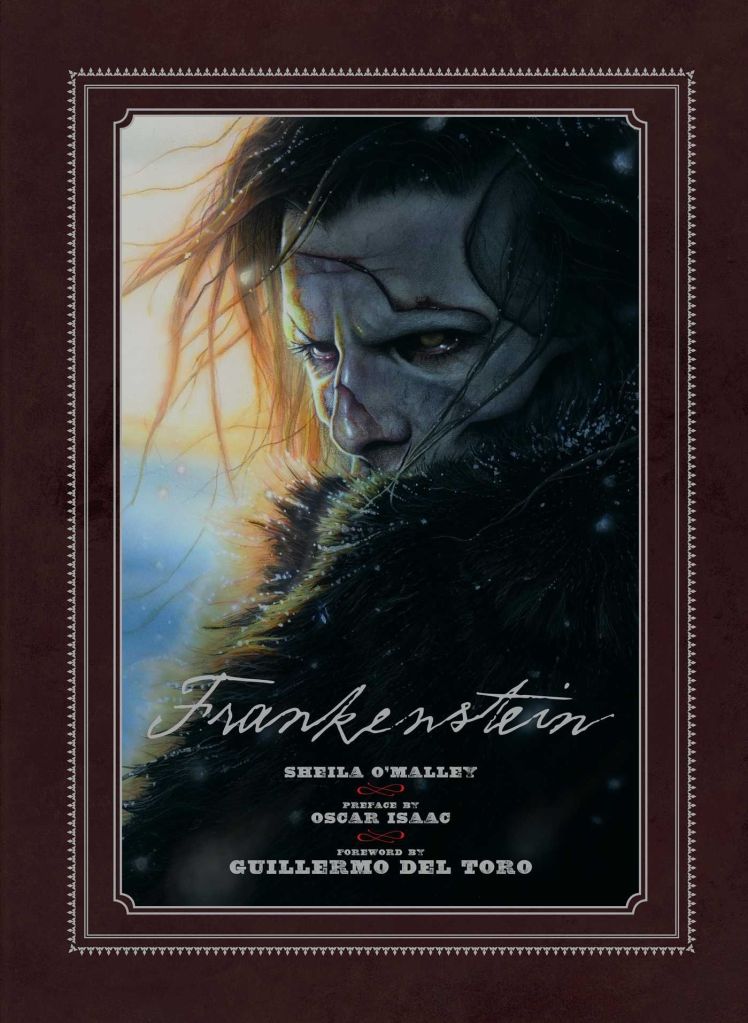
Also, del toro made a the book of frankenstein, showing the behind the scenes process, and all that this is the book i’m gonna get a copy of it soon.

 Judicious Jarrod's Every-Flavor Entertainment and Media Reviews