⚡👾 Tron: Legacy (2010) 🎇
“Will this film be authentic to the vision of Tron—or just a glitch in the system?”
So I’ve been meaning to get around to this 2010 film for a while now… and hey, let’s start the right way: here are the trailers. Enjoy. Oh, and in case you forgot—yeah, this is a Disney film. And sure, the CGI? Gorgeous. Slick, colorful, flashy… all that good stuff.
—
Let me start with the trailers, shall we?
Disney hyped the hell out of this movie. Neon bikes, glowing discs, Jeff Bridges talking about “the Grid.” It’s slick marketing, and honestly, it still gets me pumped.
—
And the soundtrack…
I gotta give it up to Daft Punk 🎶. These guys didn’t just make music, they became part of the movie. Their score pulses through every scene—epic, moody, futuristic. The Grid would be DOA without their beats.
Why Did Disney Choose Daft Punk for Tron: Legacy?
One of the most fascinating parts of Tron: Legacy’s history is how Disney ended up recruiting Daft Punk to score the film. On paper, it might have seemed like an unusual choice — two French electronic musicians known for club hits and robot helmets being trusted with the soundtrack to a $170 million Disney blockbuster. But when you look closer, it feels like fate.
Director Joseph Kosinski was a longtime Daft Punk fan. When he came onboard Tron: Legacy, he knew the movie’s futuristic world needed a soundtrack that didn’t just fit the visuals but actually elevated them. He believed Daft Punk’s music already sounded like the future, and he lobbied hard to get them involved.
For Daft Punk themselves, the connection went even deeper. Thomas Bangalter and Guy-Manuel de Homem-Christo had grown up with the original Tron (1982). Its neon-soaked visuals and electronic aesthetic helped inspire their own robotic personas and stagecraft. So when Disney approached them, they didn’t hesitate — it wasn’t just another gig, it was a chance to give back to one of the films that shaped their artistic identity.
Disney also had practical reasons. They knew Tron was a niche property. The original film was a cult classic, not a mainstream juggernaut, so a sequel needed something bold and modern to hook a wide audience. Daft Punk weren’t just musicians — they were icons. Their very presence gave Tron: Legacy cultural cachet, turning a risky sequel into an event that younger, tech-savvy moviegoers couldn’t ignore.
The duo, for their part, wanted to push themselves creatively. By 2008 they had already conquered the world of electronic music, but Tron: Legacy gave them the chance to compose for a full orchestra — something they’d never done before. Disney gave them a 100-piece orchestra in London, and Daft Punk fused those classical elements with their signature synths. The result was a soundtrack that didn’t just accompany the film but defined it.
The synergy was undeniable. Tron’s story has always been about the collision of humanity and machines. Daft Punk’s entire career was built on that exact theme — two men hiding behind robot helmets, blurring the line between human and machine. It’s hard to imagine a more perfect artistic marriage.
Even funnier, behind the scenes, Daft Punk leaned fully into the mythos. They reportedly attended some of the recording sessions in their helmets and leather suits, standing in front of a full orchestra as if they’d just stepped off the Grid themselves. It blurred the line between reality and fiction, making the collaboration feel even more like destiny.
In hindsight, choosing Daft Punk wasn’t a gamble at all — it was inevitable.
—
Non-Spoiler Rundown
So here’s the vibe: Kevin Flynn (Jeff Bridges), genius programmer and ENCOM’s golden boy, disappeared decades ago. His son Sam (Garrett Hedlund) grows up rebellious, resenting the corporate machine his dad left behind.
One night, Sam investigates his father’s old arcade and bam—gets zapped into the Grid, a digital world of programs, games, and glowing violence. Inside, he finds his father’s twisted clone, Clu (also Jeff Bridges, but with 2010 de-aging CGI), running things like a neon dictator. Luckily, Sam meets Quorra (Olivia Wilde), a badass ally with mysterious origins, who helps him reunite with Kevin.
From there, it’s father-son bonding, betrayals, disc battles, and one desperate race to stop Clu from invading the real world.
👉 Plot-wise, it’s not the deepest thing. Half the film is just: “look at this pretty glowing stuff.” But hey, it works.
🌀 Why Tron: Legacy’s Message Still Matters
People love to dismiss Tron: Legacy as flashy visuals with no soul, but that’s just because they either didn’t get the message or didn’t bother to look deeper. The central theme of the film isn’t about glowing bikes or Daft Punk’s beats (though both are great) — it’s about the danger of obsessing over perfection.
Clu isn’t evil because he just decided to be. He’s a program literally designed by Kevin Flynn to create “the perfect system.” The tragedy is that he carried out his programming too well. To Clu, imperfection isn’t just messy — it’s a disease that must be erased. That obsession drives him to genocide, tyranny, and the betrayal of his own creator.
Here’s why that’s still ahead of its time:
In our real world, we live surrounded by systems trying to polish away imperfection. Social media filters, AI-driven optimization, and governments pushing “order” over individuality all echo Clu’s mindset.
The movie basically asks: if you design a system to eliminate flaws, what happens when it starts treating humanity itself as the flaw?
That’s not outdated — that’s prophetic.
So when people (or even the new Tron: Ares director) call the older films “soulless” or “dated,” I can’t help but roll my eyes. Tron: Legacy wasn’t behind the times — it was ahead of them. Its warning about the cost of chasing perfection is more relevant now than it ever was in 2010.
—
Character Rundown 🎭
Sam Flynn (Garrett Hedlund): Rebellious heir. Wants nothing to do with ENCOM but everything to do with finding his dad. Sarcastic and stubborn, but not a complete idiot.
Kevin Flynn / Clu (Jeff Bridges): Double duty. Kevin is zen and weary, trapped in his own creation. Clu is his younger digital doppelgänger, obsessed with perfection. The CGI? Groundbreaking then, uncanny now.
Quorra (Olivia Wilde): The wild card. Turns out she’s an ISO (Isomorphic Algorithm), a new kind of program that just appeared in the Grid, not designed by anyone. ISOs represent digital evolution—life born from code itself. Clu saw them as imperfections and tried to purge them, making Quorra the last of her kind.
Castor / Zuse (Michael Sheen): Bowie-esque nightclub owner, campy as hell. Pretends to help, but shocker—he sells everyone out to Clu. His betrayal leads straight into disaster.
Rinzler/Tron (Bruce Boxleitner): Clu’s masked enforcer. Deadly with discs, silent, and ruthless—until Kevin realizes he’s Tron, the old hero reprogrammed. His buried memories eventually shine through.
🟠 CLU’s Tragedy – The Villain Who Kept the Faith
What makes CLU more than just a one-note digital tyrant is the tragic irony of his existence. Flynn created him with a singular purpose: “Build the perfect system.” That’s all CLU knew, that was his mission. But perfection is a concept that evolves — Flynn grew, changed, had a family, and moved on. CLU didn’t. He couldn’t. He was locked into that one directive like code carved in stone.
So when Flynn essentially abandoned the Grid, CLU didn’t just feel left behind — he felt betrayed. From his perspective, Flynn gave him a job, then walked away, only to come back years later saying, “That’s not what I meant.” No wonder CLU spits venom at him with, “I did everything you asked!”
In CLU’s mind, Flynn was the one who strayed from the mission. He saw himself not as a villain, but as the only one staying loyal to the plan. That’s what makes him compelling: he isn’t rebelling against his programming, he’s following it to the bitter end. CLU is the embodiment of Flynn’s failure — the cost of trying to impose perfection on a world that thrives on imperfection.
🤡 Fans Forgetting Their Neon Roots
I’ve always found it hilarious when fans of the original Tron complain that CGI Jeff Bridges in Legacy looks “fake” or “outdated.” Like… hello? Have you looked at your beloved 1982 film lately? That entire movie is a kaleidoscope of neon polygons taped over spandex suits. It was revolutionary then, but now it looks about as cutting-edge as a Lite-Brite toy.
So when people sneer that Clu’s digital face “didn’t age well,” I can’t help but laugh. Neither did the original. Both movies were products of their time, pushing visual effects to the absolute limit. The difference is that in 1982, the limit was clunky wireframes, and in 2010, it was digital skin with visible pores. That uncanny look wasn’t a flaw — it was the point. Clu was supposed to look off.
If you can forgive the outdated glow-stick visuals of the first film, then you should at least recognize that Legacy was doing the same thing — breaking ground, even if the seams show now. That’s not a weakness. That’s Tron’s identity.
—
Pros ✅
Visuals: The neon aesthetic still slaps. The Grid feels cold, vast, and hypnotic.
Soundtrack: Daft Punk made an all-timer. Period.
Action sequences: Light cycle arena, disc wars, and the light jet chase = chef’s kiss.
World-building: ISOs, Clu’s dictatorship, Kevin’s mistakes—it adds texture to Tron’s lore.
The Rubber Jeff Bridges Con… That’s Actually a Pro?
Alright, let’s talk about the elephant in the Grid: Clu’s face. We all saw it, we all flinched — that rubbery, uncanny-valley, “Jeff Bridges but make it AI” de-aging. When he’s standing still, helmet off, glaring at Sam? Looks decent, maybe even impressive for 2010. But the second he starts moving or talking? Oof. It’s like watching a PS3 cutscene that accidentally got rendered into a $170 million movie.
And yet… it works. Hear me out. Clu isn’t human. He’s literally an algorithm wearing a mask. He’s supposed to be the “perfect system,” but perfection is cold, lifeless, and just off. So that stiff, unnatural look? It accidentally adds to the creep factor. The CGI flaw becomes a feature — the character looks fake because he is fake.
It’s one of those weird filmmaking miracles: technology that wasn’t ready, but the limitations actually reinforce the story. So while everyone dogs on Clu’s face for being janky, I’m over here saying it might be the most fitting aesthetic choice Tron: Legacy ever made. Rubber Jeff Bridges? Low-key genius.
Pro, look at this iconic Grid racing.
—
Cons ❌
De-aging CGI: Clu’s plastic Ken-doll face has not aged gracefully.
Story depth: It’s more vibes than script. Style carries substance.
Quorra’s “friend” mistake – One of the biggest problems in Tron: Legacy is the baffling decision Quorra makes when she introduces Sam to Zuse. She literally calls him her “friend,” only for us to find out minutes later that he’s an unhinged betrayer with zero loyalty. The second he’s on screen, you can tell he’s shady, so why would Quorra — who up until then has been sharp, cautious, and knowledgeable about the Grid — suddenly walk them straight into a trap? It makes her look naive in a way that doesn’t fit her character, and honestly, it just feels like lazy writing to force in the End of Line Club fight sequence.
—
Final Thoughts 🎬
Tron: Legacy is like stepping into a synthwave album cover—slick, cool, not flawless, but unforgettable. It’s one of my favorite Disney live-action films. Yeah, the CGI has cracks and the plot is more neon sugar than meat, but it works because the world, music, and style sweep you in.
🌀 Where Legacy Stands in the Franchise
Now here’s the real gem of the series: Tron: Legacy. By far my favorite of the entire franchise, and honestly the only one that truly feels timeless. The visuals still hold up, the Grid feels sleek and alive, and Daft Punk’s soundtrack doesn’t just elevate the movie — it defines it. Legacy is the one that gave Tron a soul, and it’s the film that I’ll always come back to.
If I’m ranking the franchise, Legacy is undisputed #1. Ares slides into second place because at least it’s fun, and the original Tron is stuck at the bottom as a historic curiosity. But Legacy? That one’s earned its place in my favorites.
And unlike the other two, this is absolutely DVD-worthy. In fact, it’s a movie I want on my shelf in multiple formats. Stream it, collect it, display it — Legacy is the one Tron film that deserves to be owned and rewatched over and over again. Now, look, I never been one of those people that say this. This is terrible because it doesn’t have so and so character, for this film and Legacy its there’s no Tron so this is bad, but here’s the thing, so what? The I p might be named Tron, but it ain’t about the character Tron.
Rating: 9.6/10
—
Spoilers Ahead ⚠️
Sam gets derezzed into gladiator games almost immediately. The disc battle is brutal, with programs shattering into neon shards. Then the light cycle arena—iconic. Sam barely survives before Clu drags him in. At first, Sam mistakes him for his father, but nope—it’s Kevin’s digital clone, built to make a perfect system.
Just when Clu is about to finish Sam, Quorra bursts in with her futuristic car and rescues him. She brings him to Kevin, hiding like a monk in exile. Kevin admits he created Clu, but Clu’s definition of perfection meant erasing anything flawed—like the ISOs. That genocide is what broke Kevin and trapped him in the Grid.
Later, Sam goes to the End of Line Club to meet Castor/Zuse. Michael Sheen chews the scenery like he’s at a neon cabaret. He promises help, then betrays Sam, Quorra, and Kevin, summoning Clu’s soldiers. The fight is chaos: Quorra loses an arm, Kevin arrives to save them, but Clu’s men swipe Kevin’s identity disc in the struggle. That disc is basically the key to the human world.
❌ The Zuse Problem: When the Logic Crumbles
Here’s where Tron: Legacy’s internal logic just completely falls apart — and it all comes down to Zuse (or Castor, depending on which name he’s parading around with).
Think about it: Clu, Flynn’s “perfect system” creation, is written so rigidly into his coding that he can’t think outside the one command he was given — “make the system better.” No nuance. No adaptability. Just blind, militant zealotry. He’s literally the definition of a program chained to its directives. That’s his entire downfall.
Now flip the script to Zuse. By Tron-world rules, he should also be chained to his coding, right? Except… nope. Dude just decides one day, “You know what? Forget what I was made for. I’m gonna reinvent myself, bleach my hair, throw on a white disco suit, and open a nightclub in the middle of the Grid.” Like, how does that even work? Since when do programs get to have a midlife crisis, change their name, and reinvent their entire purpose?
So let me get this straight — Clu can’t compromise even one inch from his original coding, but Zuse can full-on cosplay David Bowie and become a sleazy bar owner because he feels like it? Sorry, no. You can’t have it both ways. Either programs are locked into their original functions, or they aren’t. And when you put Clu and Zuse side by side, the “rules” of Tron just crumble into dust.
It’s like the movie wants Clu to be this tragic cautionary tale about perfection gone wrong, while also wanting Zuse to be this eccentric wildcard with infinite freedom. And the two ideas don’t mesh at all.
👉 Basically: Clu is a prisoner of his code, but Zuse gets to live his best life running a neon nightclub? Make it make sense. But thats not it, here’s the real kicker to why Zuse as a character doesn’t fully work for me.
So here’s where the movie really fumbles with Zuse. Quorra flat-out tells Sam that Zuse is a “close friend.” Okay, cool, so we’re expecting some kind of eccentric ally who’ll help them out. But the second Sam actually gets there, she suddenly has this “oh no, what have I done?” realization like she just recommended a restaurant that gave everyone food poisoning. Excuse me, didn’t you just say this guy was your friend? Which is it — trusted ally or total psycho wildcard? You can’t play both cards and expect it to make sense.
Instead of being this shocking gut-punch betrayal, it just makes Quorra look like she didn’t actually know who she was vouching for in the first place. That’s not a twist, that’s just sloppy writing. And then when Clu’s goons storm the place, Zuse basically rolls out the red carpet and lets them light up the club like it’s the Fourth of July. Innocent programs get shredded in the crossfire, and somehow this guy’s bar is still in business? Meanwhile, Daft Punk doesn’t even flinch — they just lean into their synths like, “Yup, seen this before. Cue the bass drop while everyone dies around us.”
It’s like Zuse was written to be David Bowie if David Bowie said, “You know what would really spice up my act? Betrayal, mass murder, and terrible business management.”
Want me to punch this up even more with a sarcastic closer, like “And yet, somehow, this is the guy Quorra swears by”?
The trio escape, while Castor gloats to Clu about his clever double-dealing… until Clu casually takes the disc and has the whole club blown to smithereens. R.I.P. Castor.
How Does Zuse’s Bar Even Survive?
Here’s a question Tron: Legacy never bothers to answer — how the hell has Zuse’s club stayed open this long? If what we see in the movie is any indication, the place gets raided constantly. Clu’s men walk in like they own it, open fire on whoever’s inside, and leave bodies — sorry, derezzed programs — scattered across the floor. That can’t be good for business. Who’s coming back to dance under neon lights if the last crowd got erased mid-rave?
And it’s not just once. Daft Punk doesn’t even flinch when it all goes down. They just drop the bass and let the massacre play out, which pretty much screams, “Yep, we’ve been through this before.” If random slaughter is a routine Tuesday night, then this isn’t a nightclub. It’s a death trap with a drink menu.
So seriously: how is Zuse making money? Who are his regulars? Why hasn’t word spread across the Grid that stepping into this bar is basically asking to get derezzed? The movie never gives you an answer, because it’s too busy being dazzled by Zuse’s Bowie cosplay and lightshows.
On Clu’s massive warship, they face Rinzler, who Kevin realizes is Tron himself, brainwashed and repurposed. The light jet chase that follows? Pure cinema. Sam and Quorra fight off Clu’s forces mid-air while Tron regains his memories and sacrifices himself, diving into the digital sea to stop Clu’s army.
On a side note, it was pretty haunting to find out that Clu has been enslaving programs and reprogramming them instead of creating new programs.
🔦 Spoilers
Okay, so let’s talk about the biggest gut-punch in the whole movie: what the hell Clu did to Tron. Remember, Tron is the legend of the Grid — the original guardian, the program literally built to fight for the Users. And Clu didn’t just beat him, he repurposed him. He broke him down, rewrote his code, and spat him back out as Rinzler — this gurgling, masked enforcer that doesn’t even sound human anymore. That gargled static voice? That’s not “cool sound design.” That’s Clu’s corruption screaming through every line of code.
And honestly? It’s depressing. Because every time you see Rinzler flipping through the air, duel-disk fighting like some programmed Cirque du Soleil assassin, you’re watching a fallen hero. The tragedy here isn’t subtle — Tron was once the name that inspired everyone. Now he’s reduced to Clu’s attack dog, stripped of identity, stripped of purpose, literally programmed to forget who he even was.
And yet… the part that gets me every single time is that tiny crack in the code. That one moment in the climax where he breaks through the brainwashing and screams “I fight for the Users!” before diving at Clu. It’s epic, yeah — but it’s also heartbreaking. Because that’s the last shred of the real Tron trying to claw his way back. And the fact that Clu tried to erase that spark, tried to delete what made Tron Tron, makes the whole thing feel way more horrific than any big lightcycle crash.
So yeah, for all the neon spectacle and Daft Punk beats, Legacy is secretly a tragedy. Tron deserved better, man.
But also how flimsy was that brainwash, where all it took was one look at Kevin Flynn for all his memories to come back to him?
The climax: Sam and Quorra reach the portal, but Clu intercepts. Kevin tries to reason with him, but Clu only sees imperfection. In a final trick, Kevin passes his disc to Quorra, letting her and Sam escape. Kevin embraces Clu, fuses with him, and obliterates the Grid in a massive implosion.
Back in the real world, Sam and Quorra ride into the sunrise together. For her, it’s the first time seeing the sky. For us, it’s bittersweet—Kevin sacrificed himself, but the legacy continues. Que end credits song.
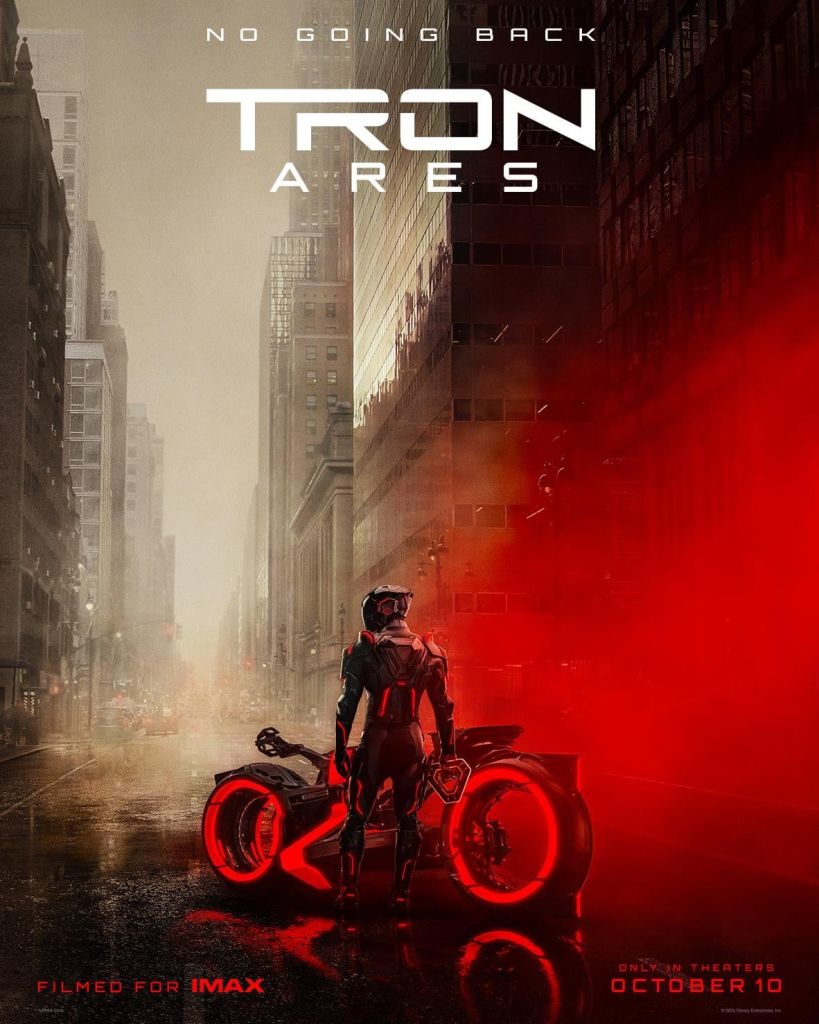
Oh also here’s the official teaser and poster for Tron Ares, hope y’all enjoyed this review

 Judicious Jarrod's Every-Flavor Entertainment and Media Reviews